
I recently attended the Australian & New Zealand Marketing Academy (ANZMAC) 2025 Conference, hosted by Macquarie University here in Sydney. The theme this year was “Riding the Waves: Navigating Marketing’s Dynamic Landscape”.
Attending a conference in your home city is a distinct experience compared to travelling abroad. While you avoid jet lag, you don’t quite escape the realities of daily life. For me, living in Marrickville meant a commute of over an hour to the Macquarie Park campus. Balancing the conference with the “school run” drop-offs, pick-ups, and cooking dinner meant I unfortunately had to miss the social events on Monday and Tuesday nights.
However, I did manage to inject some gamification into the commute. One day, I decided to cycle my e-bike to the nearest Metro station, take the train, and then cycle from the station to the Macquarie Theatre for the keynote. I managed to make the door-to-door trip in under an hour. Level up!
Fortunately, “Grandma” saved the day on Wednesday, taking over childcare duties so I could attend the Gala Dinner at Doltone House in Pyrmont. It was a wonderful night and a great opportunity to catch up with old friends, including my very first PhD student, Ash Powell, who is now doing brilliantly in her academic role at Flinders University.
Major Highlight: AMI Grant Win
The highlight of the conference was undoubtedly winning the Australian Marketing Institute (AMI) – ANZMAC Applied Research Grant alongside my colleague Dr Eunbin O.
We were awarded funding for our project: “Navigating the Gamification Dilemma: Optimising Loyalty Program Design for Engagement and Choice.”
This project addresses a critical challenge we call the “gamification dilemma”: how to leverage gamified loyalty programs for engagement without overwhelming consumers with excessive information or complex choices. We will be partnering with StampMe.com, a leading digital loyalty platform, to run field experiments testing whether allowing customers to customise their gamified experience can reduce cognitive overload.
Research Presentations
It was a busy week for the team, with three key papers presented:
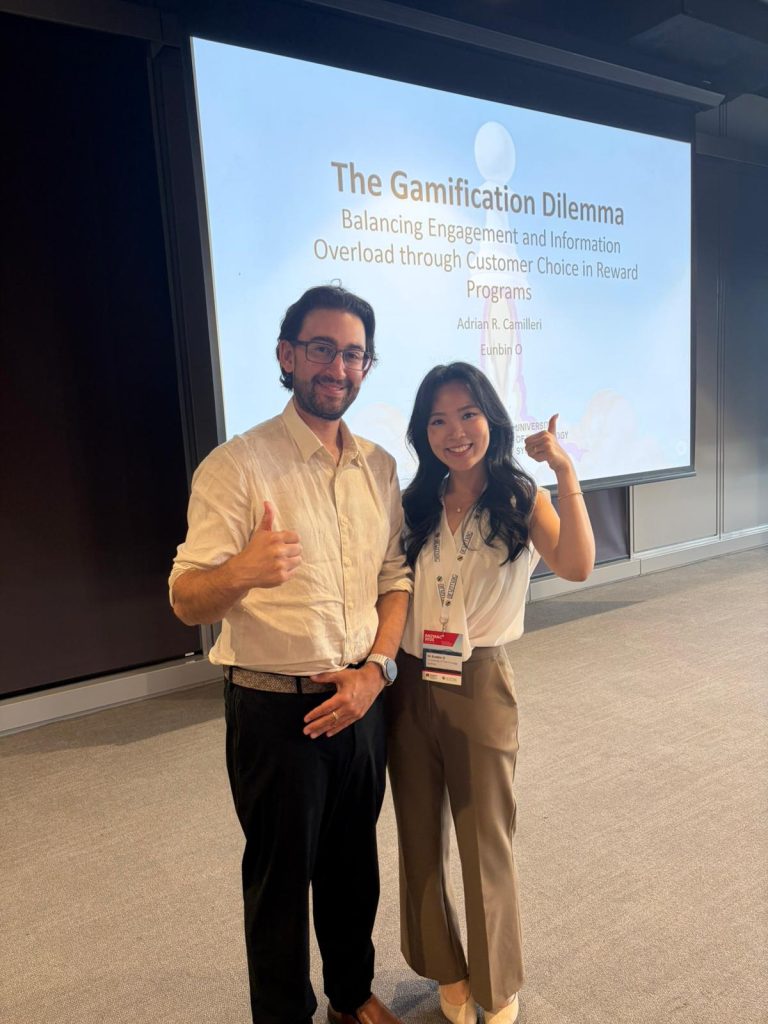
1. The Gamification Dilemma Co-authored with Dr Eunbin O
I presented a talk based on the preliminary work for our grant. We investigated whether adding game mechanics to loyalty programs paradoxically backfires by inducing information overload. Using a sophisticated digital banking simulation, we found that while more gamification features initially increased spending and loyalty, they also increased perceived information overload. Critically, our results suggest that allowing users to self-select their preferred game elements helps mitigate these negative effects—moving beyond a “one-size-fits-all” approach to one of consumer empowerment.
2. Self- vs. Other-Oriented Framing in Scam-Prevention Communication Presented by Dr Eunbin O (Co-authored with Dr Tom Swanton)
Dr Eunbin O presented fascinating findings from a large-scale field experiment conducted in partnership with a major Australian financial institution, involving over 600,000 customers. The study looked at how to improve engagement with scam-prevention emails. Interestingly, the results revealed that older customers with high income levels were significantly more likely to open emails when the subject line used “other-oriented” framing (focusing on protecting others) rather than self-interest. This offers actionable guidance for banks aiming to improve the reach of their safety messaging.
3. Nudges Worth Implementing: Ethical, Effective Strategies for Sustainable Meal Choices Presented by Nathan Moore (Co-authored with Prof Ben Newell and Prof John Roberts)
My PhD student, Nathan Moore, did a stellar job presenting his research on sustainable food choices. He tested digital nudges to encourage lower-carbon meal selections. The standout finding was the success of the “self-nudge”—where participants actively chose whether or not to receive nudges. Not only was this strategy effective, but 80% of participants voluntarily chose to receive the nudges. It suggests that people are open to support in making sustainable choices when their autonomy is respected.
Overall, it was a productive week of sharing ideas and planning future research. I look forward to seeing everyone at the next ANZMAC!